

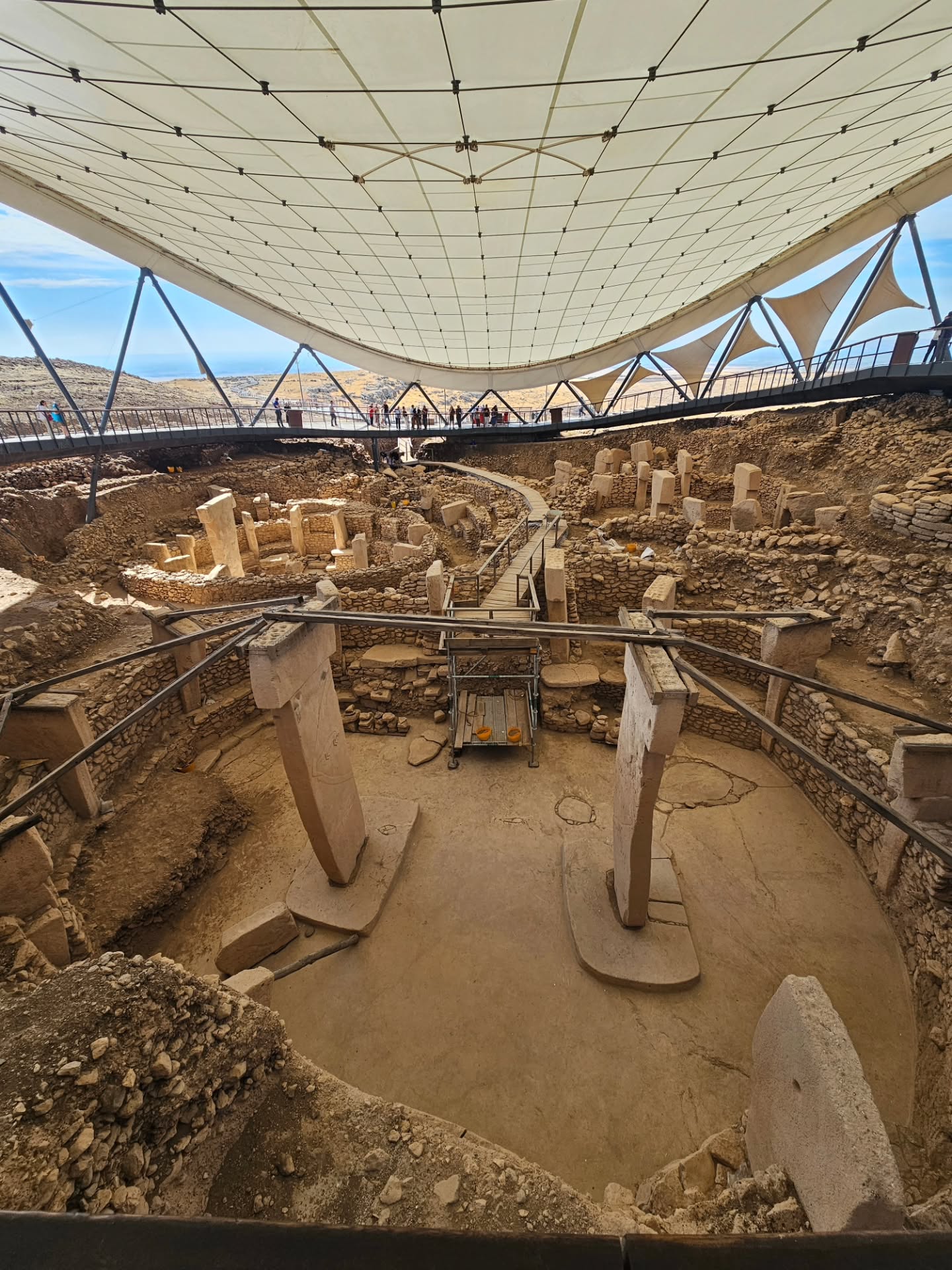
Hunter-gatherers raised circles of carved T-shaped limestone pillars on this ridge about 11,500 years ago — roughly 6,000 years before Stonehenge and 7,000 before the Great Pyramid, without farming, pottery, or the wheel. Today you walk a railed boardwalk beneath a protective canopy, looking down on Enclosure D's twin central pillars, 5.5 metres tall, carved with foxes, snakes, cranes and the famous Vulture Stone.
Find Guided ToursHunter-gatherers built the world's oldest known monumental temple complex on a limestone ridge 15 km northeast of Şanlıurfa, and they did it between roughly 9600 and 8200 BCE. That's 6,000 years before Stonehenge's earliest stage and 7,000 before the Great Pyramid. Today you view the round and rectangular enclosures from elevated boardwalks beneath a protective canopy, looking down on T-shaped limestone pillars the way archaeologists do.
Before Göbekli Tepe, scholars assumed farming came first and monumental building followed. This site flipped that. The enclosures went up in the Pre-Pottery Neolithic, before agriculture or pottery, by people who carved the pillars with reliefs of foxes, wild boar, snakes, cranes and vultures. Some monoliths carry arms, hands, belts and loincloths in low relief — the T-shape reads as a human body seen from the side. UNESCO inscribed the site on the World Heritage List in 2018, calling it one of the first manifestations of human-made monumental architecture.
The scale is hard to credit. Central pillars rise up to 5.5 m, with weight estimates running from about 10–16 tonnes to as high as 40 tonnes in official Turkish descriptions. The workers quarried them from bedrock pits roughly 100 m from the hilltop, and unprocessed cut stones still lie on the plateau where they left them. Enclosures measure 10–30 m across.
Its Turkish name means 'potbelly hill,' a rounded limestone rise at about 760 m in the Germüş range. A 1963 survey dismissed the mound as a probable Byzantine cemetery; German archaeologist Klaus Schmidt recognized it in 1994, and excavations ran from 1995 to 2014. Necmi Karul now leads the work. Four large enclosures are unearthed, geomagnetic surveys suggest at least 20, and only 5–10% of the mound has been dug. Most of it is still waiting.

Discover the full history and cultural significance on our About page.
From the railed boardwalk beneath the protective canopy, you look down on twin central T-pillars rising more than 5 metres, ringed by monoliths carved with foxes, snakes, wild boar and cranes. It's the largest and best-preserved enclosure — the one UNESCO cites among the first monumental architecture ever built.
Pillar 43 is the site's most famous carving: vultures, a headless human figure, a scorpion and abstract symbols. Some scholars argue the imagery encodes an astronomical event. Find it at the Enclosure D viewpoint and give your eyes a minute — the low relief reveals itself slowly.
Look closer and several pillars turn out to be people: low reliefs of arms, hands, belts and loincloths. The T-shape is an abstract human body seen from the side, and the official text describes these cubic beings as figures from 'another dimension'. Standing in front of one is unsettling in the best way.
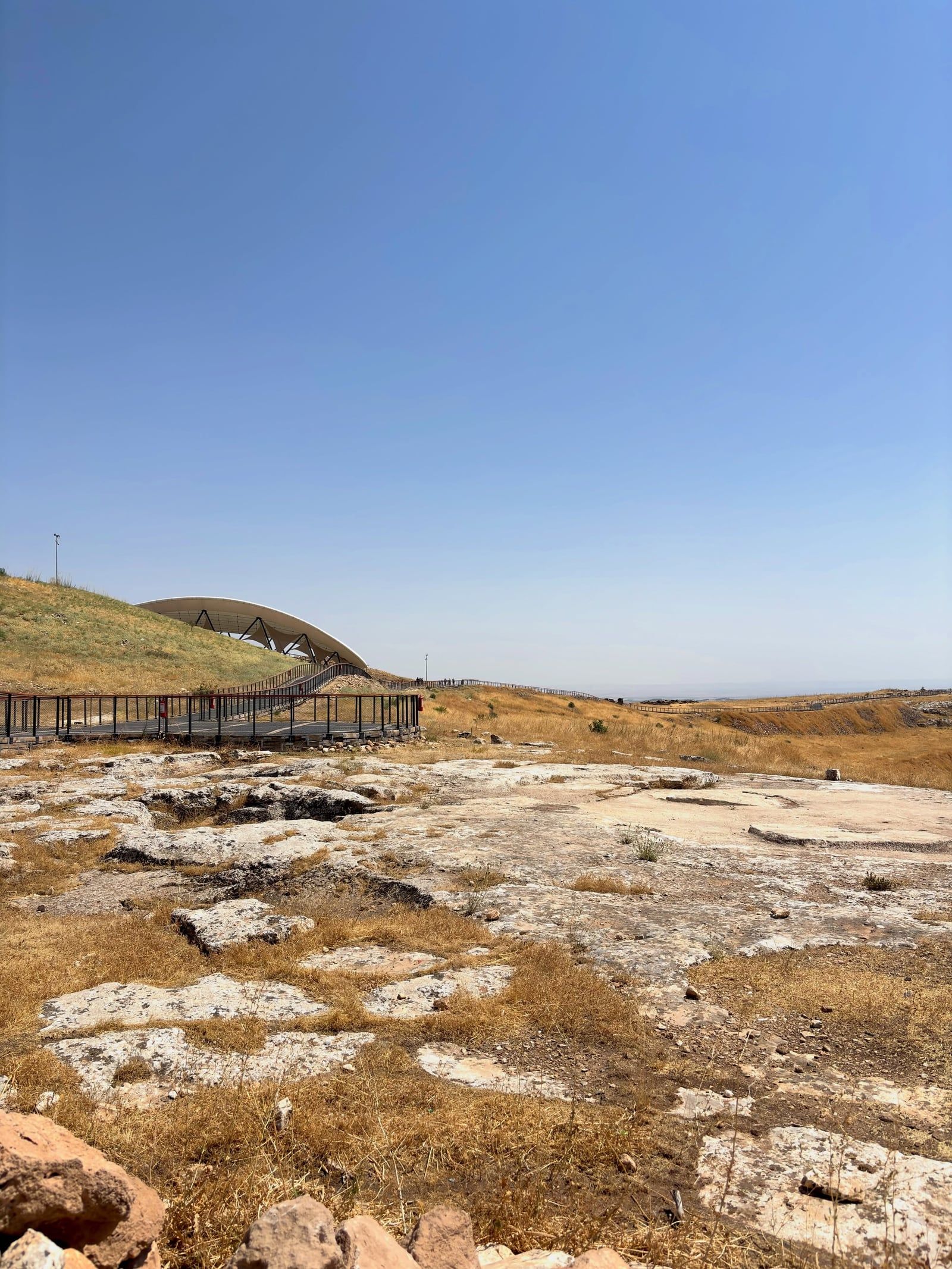
Early morning or late afternoon light turns the limestone pillars honey-gold over the Harran Plain. Walk the mound's edge and you can still spot unprocessed monoliths lying where Neolithic workers cut them from bedrock quarries roughly 100 metres from the hilltop. Bring a camera; the light fades fast.
Book a licensed-guide tour to the world's oldest temple site from $175, with private transport and free cancellation up to 24 hours.
Swipe to see more
Aim for March to May or September to November, when mild temperatures suit the exposed boardwalk loop and the light on the pillars is at its best. Skip July and August, when Şanlıurfa regularly tops 40°C on a shadeless limestone ridge.
Mild walking weather and wildflowers across the plateau, with April especially rewarding. Thin crowds and full daylight hours before the summer opening-time crunch.
Şanlıurfa is one of Turkey's hottest cities — temperatures regularly exceed 40°C (record 45.2°C in August 2019) and the ridge has almost no shade. Only realistic right at the 08:30 opening.
Cooling temperatures, golden light on the limestone pillars, and thinner crowds than the peak months. Comfortable conditions for the full boardwalk circuit and photography.
Cold at 6–9°C, windy, with occasional frost and even snow-dusted pillars. Short daylight and an earlier 17:30 closing, though crowds are at their thinnest.
Göbekli Tepe is open every day of the year. In summer (1 April – 31 October), hours are 08:30–19:00, with the ticket office (gişe) closing at 18:30. In winter (1 November – 31 March), hours are 08:30–17:30, with the ticket office closing at 17:00. The only closure variation: on the first day of religious holidays, the site stays closed until 13:00.
| Category | Price |
|---|---|
| Foreign visitors (adult) | €20 (official e-bilet on muze.gov.tr; lira amount at the gate moves with the day's exchange rate) |
| Turkish citizens with Müzekart/Müzekart+ | Free |
| MuseumPass Türkiye holders | Includes two free visits per year; MuseumPass Plus gives unlimited entry |
| Students | Free |
| Teachers | Free |
Buy tickets at the gate or as a €20 e-bilet on muze.gov.tr (maximum 10 per order) to skip the queue — the nearby Şanlıurfa Archaeology Museum (around US$15) and Haleplibahçe Mosaic Museum (around €10) require separate tickets. Fees and hours change with little notice; the ministry's next tariff revision is scheduled for 1 April 2027, so confirm current figures on muze.gov.tr the day before your visit.
For complete schedules and ticket prices, visit our Hours & Fees page.
Göbekli Tepe sits on a limestone ridge about 15 km northeast of Şanlıurfa, reachable in 20–30 minutes by taxi or rental car via the well-signposted D400 route. Without a car, take the hourly dolmuş from the Şanlıurfa Archaeology Museum (45 minutes, card payment only).
📍 Örencik Village, Şanlıurfa Province, Turkey (15 km northeast of Şanlıurfa city centre)
The simplest option. The roughly 15 km route is paved and well signposted, and drivers are widely available in Şanlıurfa. There's no meter fare to the site, so agree the price and any waiting time before you set off — drivers will often wait while you tour. Recent visitor reports quote north of 1,000 TL for a return trip with waiting.
The budget choice. The dolmuş departs the Şanlıurfa Archaeology Museum at 45 minutes past each hour and takes 45 minutes to reach the site, covering about 15 km. Return buses leave Göbeklitepe on the hour until 18:00 — miss the last one and you're negotiating a taxi. Payment is card only (Urfakart or contactless credit card), so leave the cash at the hotel.
Turkish Airlines, Pegasus and AJet fly Istanbul (IST/SAW) to Şanlıurfa GAP Airport (GNY) multiple times daily, about 1 hour 50 minutes in the air — morning departures land around 09:25. From the airport it's roughly 40.8 km to the site: take a shuttle, bus or taxi into Şanlıurfa, then continue the final 15 km. A long day trip from Istanbul is feasible this way.
Driving yourself means following the D400 highway and the signed turn-offs to free on-site parking — about 15 km, 20–30 minutes from the city. If you'd rather skip negotiating taxi fares, organized day tours from Şanlıurfa bundle transport, a licensed guide and often Karahantepe or the archaeology museum; day tours from Istanbul are also available.
For detailed transport options and routes, visit our Directions page.
Opening at 08:30 gets you ahead of tour groups and the heat. In July and August the exposed ridge becomes debilitating by around 10:30, so early arrival is the only realistic summer strategy. Soft morning light also photographs the pillars better than midday glare.
The minibus leaves the Şanlıurfa Archaeology Museum at 45 minutes past each hour, takes 45 minutes, and costs 38 TL one way. Card or contactless payment only — no cash. Return buses leave the site on the hour until 18:00; miss the last one and you're negotiating an unregulated taxi fare.
Taxi fares to the site are unregulated, and recent visitors report paying north of 1,000 TL for a return trip with waiting. Agree the full price, including waiting time while you tour, before getting in. Drivers are easy to find in Şanlıurfa, and the 15 km route takes 20–30 minutes.
Do the exhibits, scale model and animation hall before heading up the mound — the context makes the boardwalk far more rewarding. A free shuttle covers the 1 km between visitor centre and hilltop, or you can walk it in about 15 minutes. Budget 90 minutes minimum; two to three hours with a guide.
Turkish law defines 'artefact' broadly and imposes up to ten years in prison for illegal export. Collecting or even moving stones, flint flakes or pottery from the site and surrounding fields is forbidden, and the entire site is under constant video surveillance. Look hard, touch nothing.
Entrance is officially 20 Euro for foreign visitors, but the lira amount charged at the gate moves with the exchange rate, and the ministry revises tariffs periodically — the next change lands 1 April 2027. Check muze.gov.tr the day before your visit and pre-buy the e-bilet to skip the ticket queue. Students and teachers enter free.
Holds the original Göbekli Tepe finds — leopard, boar, fox and vulture reliefs — plus Urfa Man, the world's oldest life-size human statue at roughly 11,000 years. Budget about 90 minutes; admission is separate, recently quoted around US$15.
The sister site in Tek Tek Mountains National Park, with rock-cut chambers, a monumental carved human head and T-shaped pillars echoing Göbekli Tepe. Archaeology Magazine named it one of the ten most important discoveries of 2025.
An ancient Mesopotamian city famous for conical beehive mud-brick houses whose thick adobe walls still keep out the heat, and ruins claimed as the site of the world's first university. Dolmuş connections and combined tickets make it an easy half-day trip.
Read what travelers share about their experience visiting Gobekli Tepe — from practical tips to personal highlights.


Planning advice, comparisons, and practical tips.

Twelve thousand years ago, before pottery, metal, or the wheel, hunter-gatherers on a bare hill in southern Turkey carved snakes, vultures,…

Yes — Göbekli Tepe is open to visitors, and it has never been easier to see. The world's oldest known monumental ritual complex, a mound of carved…
Foreign visitors pay €20, the official euro-denominated ministry tariff, buyable as an e-bilet on muze.gov.tr — the lira amount charged at the gate moves with the day's exchange rate. Turkish citizens enter free with Müzekart, and students and teachers are also admitted free. Tariffs are revised periodically (a new one takes effect 1 April 2027), so confirm the current price on muze.gov.tr before you go.
Roughly 6,000–7,000 years older. Göbekli Tepe's monuments went up between about 9600 and 8200 BCE, while Stonehenge's earliest stage dates to around 3000 BCE and the Great Pyramid to about 2560 BCE. Hunter-gatherers built it before farming or pottery existed.
It's open every day: 08:30–19:00 from 1 April to 31 October (ticket office closes 18:30), and 08:30–17:30 in winter (ticket office closes 17:00). The one exception is the first day of religious holidays, when the site stays closed until 13:00.
The site is 15 km northeast of the city, a 20–30 minute drive. The dolmuş leaves the Şanlıurfa Archaeology Museum at 45 minutes past each hour, takes 45 minutes, and costs 38 TL one way — card or contactless only, no cash. Taxis work too, but there's no meter fare, so agree the return price including waiting time before setting off; recent quotes run north of 1,000 TL.
Yes. Turkish Airlines, Pegasus and AJet fly Istanbul to Şanlıurfa GAP Airport in about 1 hour 50 minutes, with a morning departure landing at 09:25; from the airport it's roughly 40.8 km to the site, about 45 minutes by transfer. Domestic fares start around €40–70 each way.
Largely, yes. A free shuttle covers the 1 km between the visitor centre and the mound, and the circuit over the enclosures is a flat wooden boardwalk with railings. The stretch from the car park to the visitor centre can be uneven, so bring assistance there if needed. Note that you view the enclosures from the walkway — the trenches themselves are off-limits to everyone.
There's no dress code at the site itself, but the limestone ridge has almost no shade outside the protective canopy, so bring sun-covering clothing, a hat, sturdy shoes, and more water than you think you need — summer temperatures regularly top 40°C. If you're combining the visit with Şanlıurfa's mosques or Balıklıgöl, cover shoulders and knees for those stops.
No permit or advance booking is required — buy at the gate or pre-purchase the 20-Euro e-bilet on muze.gov.tr (up to 10 per order) to skip the queue. A guide isn't required either, since signage and the official 'Voice of Museum' audio guide cover the basics, but licensed guides add real context on the carvings and construction methods. Plan 1.5–2 hours minimum, or 2–3 with a guide.
Browse verified tours with free cancellation and instant confirmation.
Find Tours


